
Someone in your family is already keeping count. How many boxes, how many houses, who gets the good one with the silver leaf still intact across the top.
There's a particular pressure to the week before Rakhi that nobody names out loud. It isn't the gift. Gifts are solvable with a card and twenty minutes online. It's the box of Indian sweets, who you're carrying it to, and the quiet knowledge that somebody in that house holds firm opinions on mithai and will be forming one about yours.
The Offer Awaiting You at Tabla
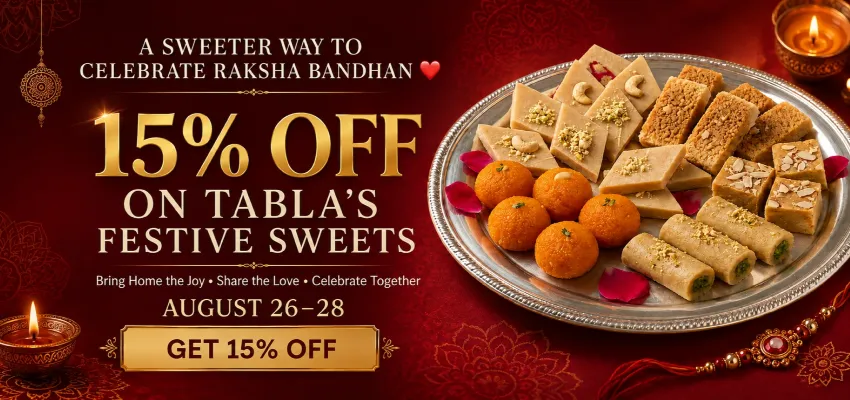
15% off, 26 to 28 August, at all Tabla locations. The discount comes off at the counter. No code to remember, no minimum spend, nothing to print or hold up on a phone. You walk in, you choose, the price adjusts. Wednesday to Friday. Three days, then it closes.
Rakhi sits inside that window wherever your family lands on it. Some households here observe on the 27th and some on the 28th depending on which panchang they follow, and this Raksha Bandhan special offer covers both. It also covers the day before, which is the smarter day to walk in and the one almost nobody uses.
The Thread Goes On, Then the Box Opens
Ask anyone who grew up with the ritual. The rakhi is tied, the aarti circles once, the tilak goes on slightly crooked because somebody's hand was shaking from laughing. Within about a minute, a ladoo is being held up to a sibling's mouth while that sibling objects loudly and eats it anyway. That order never changes. It has never changed.
Which is why sweets for Raksha Bandhan get bought before the gift does, and why they get bought properly. A wrapped present can sit on a side table for two hours while people talk. The mithai cannot wait past the first hour, because the first hour is exactly when it gets used.
Think of the morning as a sequence rather than an occasion. Thali prepared. Thread tied. Sweet given. Photograph taken, usually badly, usually with somebody mid-chew. Your box has a role in that sequence, and its role comes early.
What's Behind the Glass
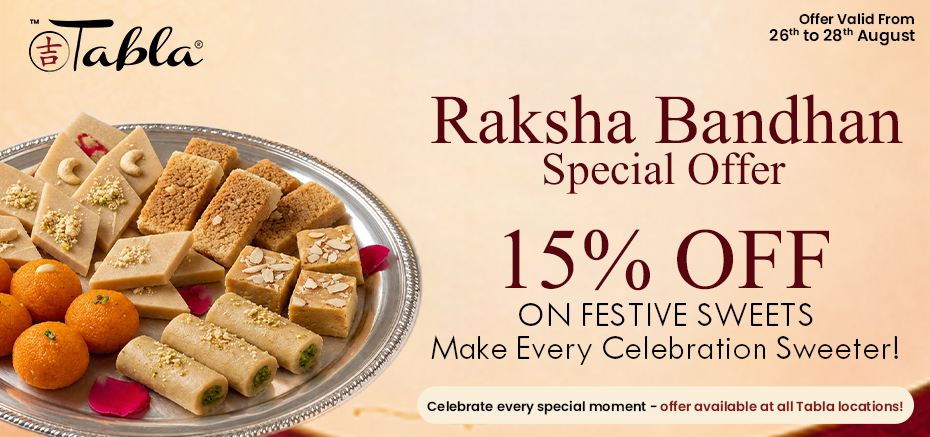
- Kaju katli cut into thin diamonds, edible silver leaf laid over the top, a dollar fifty a piece. The silver is real, in case anyone at the table asks. Beaten finer than paper, tasteless, purely a flourish inherited from the Mughal kitchen.
- Motichoor ladoo built from gram flour pearls soaked in syrup and cardamom, deep saffron-orange, holding shape until the exact second they don't. Kaju pista rolls with the green running right through the middle. Milk cake caramelized so far down it turns grainy and roasted-tasting. Gulkand petha rolls, soft, filled with rose. Punjabi chamcham sitting in their syrup, pink and white and yellow.
- Coconut milk burfi starts at a dollar twenty-five. Take the 15% off Indian sweets on top of that and a serious box stops being a serious decision. Use your fingers. Anybody reaching for a fork has misread the room.
Buy for More People Than You Invited
Count the family. Then add four. A cousin turns up unannounced, having heard there was food. A neighbor arrives with her own box, stays forty minutes, and leaves holding one of yours. Somebody's children walk in having eaten nothing since breakfast and locate the tray with the focus of a search party.
Then come the boxes you didn't plan for. One for the family who hosted you last year. One for the colleague who mentioned on Tuesday that she celebrates too. One your mother decides at nine in the morning must reach her friend across town, immediately, before anything else happens today.
Underestimating is the traditional mistake. Everyone makes it once. The people who've already made it are the ones buying on the 26th rather than paying full price two days later for a smaller box than they wanted.
Why the Sweets Matter More Than the Gift
Mithai is the only part of the day that passes directly from one person to another. The gift gets set aside and opens later, usually alone, with nobody watching. It's private by design. The sweet moves hand to hand in the room, in front of everyone, while the moment is still happening. Somebody's fingers touch somebody else's. It's the part that ends up in the photograph and the part people describe afterwards when they tell someone how their morning went.
There's a reason the ritual uses food. Food gets consumed in front of you. It asks the other person to accept it physically, right then, with their body.
Nobody wants to be the one who brought the disappointing box. It gets remembered longer than it should, and it comes up again the following year.
What Traditional Indian Sweets Actually Take
Milk, ghee, sugar, ground nuts, and patience. The list has never run longer than that, and the first four are the affordable parts. What separates a good barfi from a forgettable one comes down almost entirely to how long somebody was willing to stand over the pan. Reducing milk properly means stirring for an hour or more until it comes down to roughly a fifth of what you started with. Turn the flame up to hurry it and you get scorch where the caramel should have been.
Tabla sweets are prepared freshly. You can taste the difference between a sweet that was made and one that was assembled. So can your grandmother, who will mention it, possibly while the person who brought it is standing there.
Half of It Leaves Your House
Most of the mithai bought this week gets eaten somewhere else entirely. It goes next door to the neighbor who took your parcels all month. It travels three hours in a car boot to a brother you see twice a year, packed carefully, arriving slightly shifted. It goes to the office, where it vanishes faster than anything anyone has ever carried into that building, generally before eleven.
Some of it reaches people you won't see at all. The box left on the doorstep. The one handed across a parking lot because you were both driving somewhere else. Distance changes what Rakhi looks like, and for plenty of families the sweets are the part that still makes the journey when nobody else can.
Order the drive as well as the table. The arithmetic on Indian sweets offers shifts considerably once you count the boxes that were always going to leave. If you prefer to plan ahead, you can also order online Indian sweets for Raksha Bandhan and have your festive boxes ready before the celebrations begin.
Where to Find It
The 15% off runs at every Tabla location, same three days, same discount, whichever counter sits closest to your kitchen. Check your nearest to the Tabla locations for hours before you set out.
Call ahead for anything large. Rakhi week moves stock quickly, and a case that looks comfortably full at eleven in the morning tells a very different story by four. If you need six boxes, one phone calls the day before saves you a conversation you won't enjoy having at the register